I’ve been doing the boring task that citizens never want to do, which is watching the city council make seemingly mundane decisions over the course of an EIGHT-HOUR MEETING, here in London, Canada.
And it’s clear now that they are actively harming their constituents, or they are COMPLETELY LACKING FUNDAMENTAL UNDERSTANDINGS OF KEY CONCEPTS. They’re uninformed on how their completely hypocritical decisions disproportionately hurt those in their wards far more than anywhere else. So they’re ACTIVELY against ensuring the safety of their own constituents in order to save a few million dollars… After having given no second thoughts when it comes to a fully redundant project that staff does NOT RECOMMEND and that will cost upwards of 500 million dollars. More details to follow.
This whole meeting was WILD to witness, but today I’ll be focusing on one particularly agregious decision that will affect my neighbourhours, those who I care for, and I.
These councillors needs to the held accountable for all of their opinions that they’re or citing as facts, so let’s jump right in.
Table of Contents
- Introduction
- Background
- Safety rick
- Utility cycling VS recreational cycling
- The Letter
- 1. Cheapside Street is not a viable substitute for keeping cyclists safe on Huron Street
- 2. Budget pressure associated with these cycling network improvements is overstated
- 3. Making cycling accessible for daily trips is consistent with London’s mode share target
- Disclaimer
Introduction
It gives me no great pleasure to call out our elected representatives, but when they so blatantly go against the interests of their constituents, it leaves me no choice.
See, when elected officials put people’s lives in danger by their decisions, especially when going against plans that were previously green lit and were about to be set in motion to increase safety for their own constituents, somebody has to call them out.
And so you don’t think that it’s just me making this stuff up, I’m going to use their own words to clearly demonstrate how their statements are misinformed at best and hypocritical at worst.
Background
Before we get into the nitty gritty, you need to understand a little bit of history to set the stage.
The Mobility Master Plan has been in the works for several years now. Last week, on March 25, 2025, at the Strategic Priorities and Policy Committee meeting—also known as SPPC meeting— city staff, who have been working on this project for YEARS now, brought forward the draft network maps for committee approval.
Keep in mind that these city staff are experts in their respective fields. They include engineers, city planners, community outreach specialists, and more. After YEARS of public consultations, these subject matter experts brought forward their recommendations.
Safety risk
What happened next at this committee meeting was that Counselor Stevenson of Ward 3 put forward a motion, seconded by counselor Cuddy of Ward 4, to remove four bicycle routes on four streets in their wards.
- Huron Street, being the MOST important of them all.
- And… McNay Street, Gammage Street, and Taylor Street.
Their last-minute amendments discounted ALL of those experts, AND years of public consultation, essentially ripping the spine out of the connected network that was designed to serve their constituents.
Utility cycling VS recreational cycling
One of the main challenges that these counsellors face is that they have a FUNDAMENTAL MISUNDERSTANDING of what utility cycling is.
Utility cycling refers to getting around the city and around your neighbourhood on a daily basis, for routine things, just like what most people use driving cars for.
Utility cycling is NOT recreational cycling on the weekend. It’s everything ELSE.
For example, utility cycling is the day-to-day short haul trips to the grocery store,
or to the dentist,
or to the corner store,
Or commuting to work downtown,
Or heading out to hang out with family or friends,
You know… LIFE stuff!
As the City of London accurately states in its NUMEROUS studies and reports, most trips that Londoners take each day are LESS than 3 km; Trips that can easily be done by bicycle… IF there is safe infrastructure in and around their neighourhoods.
I NEED to make it clear that when Susan says “we can get more bike lanes once there’s more demand” she’s not understanding the other side of induced demand. You might have heard of it with “just one more lane” and that being silly… but that’s a whole other topic for another day.
But “you can’t justify a bridge by the number of people swimming across a river”
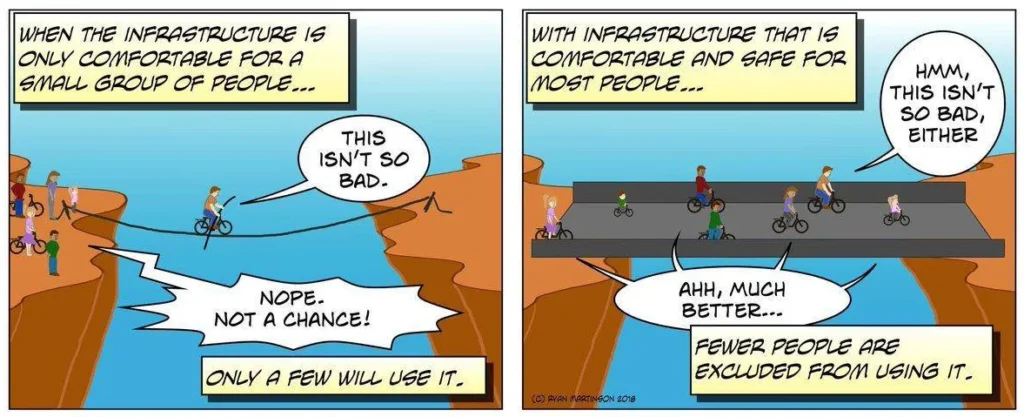
With infrastructure that is comfortable and safe for most people… fewer people are excluded from using it.
Build proper active transportation infrastructure and they will come!
Another way to look at it for drivers is “would I drive anywhere if there were no roads leading to where I need to go?”
See, without a connected, safe, efficient network for cycling and micromobility usage, which goes to the places that people need to get to (like work, grocery stores, and around the city in general for errands and living life), only the most risk-tolerant of people riding bicycles will be using the current lanes because the network is incomplete. That’s NOT a lot of people because NOT a lot of people are risk-tolerant.
What safe, connected cycling networks allow is for the people who ARE risk-adverse—so the MAJORITY of people on this planet—to get around on a bicycle.
And Susan and Peter ARE NOT GETTING THIS.
They THINK that because they occasionally ride their bicycles exclusively for recreational biking in perfect weather in the summer… that they are qualified to make decisions for people who rely on bicycles to get around for everyday life, whether by choice, or because motor vehicles are not an option for them.
If it isn’t clean enough already, another Hruon Heights member reached out to me and gave me a summary of how their chat with Peter Cuddy went, regarding this very topic, it’s it’s very telling:
***
I had my call with him – he mentioned he would follow up with Councillor Stevenson to discuss potentially amending things to get back the Taylor St and Gammage St lanes, but not holding my breath there.
*He was pretty firm in his avoidance of committing to a bike lane on Huron due to “uncertainty around planned developments” on the street to which I respectfully disagreed. I expressed that I felt like we were missing the boat on a city-wide initiative for cycling improvements.
*I also took time to mention how much I dislike the current bike lane on Cheapside due to how unsafe it feels. This was the most bizarre part of the conversation, he launched into this aside about how he actually really likes unprotected bike lanes and does not like biking on Colborne street. I thought this was really bizarre, and a little bit exclusionary to less confident cyclists.
***
– But you see, if you look at it from a lens of JUST NOT GETTING the difference between his risk-tolerant, privileged recreational cycling perspective, ALL his decisions start to make sense:
He is not comprehending the needs of his constituents and is instead, honestly, being very selfish.
Because Peter, let me ask you this: do you KNOW what AAA cycling infrastructure is? As in All Ages and Abilities? So the school children that your preventing from biking to around? And those with mobility issues? And ANYONE ELSE other than confident cyclists?
You yourself said to me, at my front door, that I’m just the one percent of people who bike year-round. That’s BECAUSE OF DECISIONS LIKE THESE: to not build safe infrastructure!
***
Didn’t expect much from the call, but yeah it sort of matched your experience of him having his opinion set on the Huron St part. To his credit, I did find him generally receptive to most other things (though still, not holding my breath)
He mentioned briefly about Huron St becoming a more major artery in the city in the years to come. I can’t shake the feeling that they’re opposing bike lanes because someone is going to propose widening [Huron Street to 2-lanes each way] (fully killing the neighbourhood)
***
I also took time to mention how much I dislike the current bike lane on
This isn’t the only factor, but I’ll dive deeper in just a bit.
Unfortunately, the motion put forward by counsellors Stevenson and Cuddy was passed by the committee. So it’s not ONLY on these two councillors who voted to make this happen, but on all nine committee members on screen right now:
- Rahman
- Morgan
- Pribil
- Cuddy
- Van
- Hillier
- Lehman
- Lewis
- Stevenson
But I’m very disappointed that Susan and Peter fought so hard for this, and “informed” their fellow councillors with false facts about their wards.
With that, ALL of the public consultation, and ALL of the work and advice of ALL the experts on these four streets was immediately dismissed.
If these amendments are then approved at the larger council meeting on April 1st, the very lives of the people who live and work in wards THREE and FOUR will be unnecessarily put at risk, all to save a few dollars.
But more on that in a few minutes… because this gets even MORE interesting, the further we dig in.
Keep in mind that the master mobility plan is going to provide the strategic direction for how our transportation system will look over the next 25 years in London, so what we’re talking about truly matters.
The Letter
Okay, here we go.
I’d like to take a moment to go through a letter written by the Old North East (ONE) Neighbourhood Association, because it’s SO well written and covers everything I was initially going to talk about. I scrapped half of my script to include this, so I hope those hours of my life mean something to you.
I’ve modified a few things for video reasons and added a few of my own bits to enhance understanding. If you’d like to read their official letter, I’ll link it in the description.
The Neighbourhood Association is concerned with the changes to the cycling network map in their neighbourhoods.
They oppose the removal of cycling network additions at the following four streets: Huron, Taylor, McNay and Gammage—and they urge council to restore these improvements that were proposed by the city’s transportation planners and engineers, based on extensive study and consultations with our communities.
These cycling network connections keep our residents safe.
- Even if councillors keep on saying that they are redundant, they’re not.
- They are also NOT prohibitively expensive to build or to maintain, and
- They are NOT unsafe, as was suggested by Councillors Cuddy and Stevenson—quite the opposite.
The neighbourhoods surrounding these proposed cycling network improvements are home to a relatively high proportion of low-income residents who are more likely to rely on cycling and other non-vehicular transportation for their daily mobility needs. So, removing these cycling network improvements is an equity issue.
Streets implicated in this decision are used by our residents to reach destinations such as schools, grocery stores, general stores, churches, commercial plazas, industrial workplaces, restaurants, apartment buildings, and more. EVERYTHING! They’re all destinations that would be easily reached by bike, if the cycling network improvements weren’t scrapped.
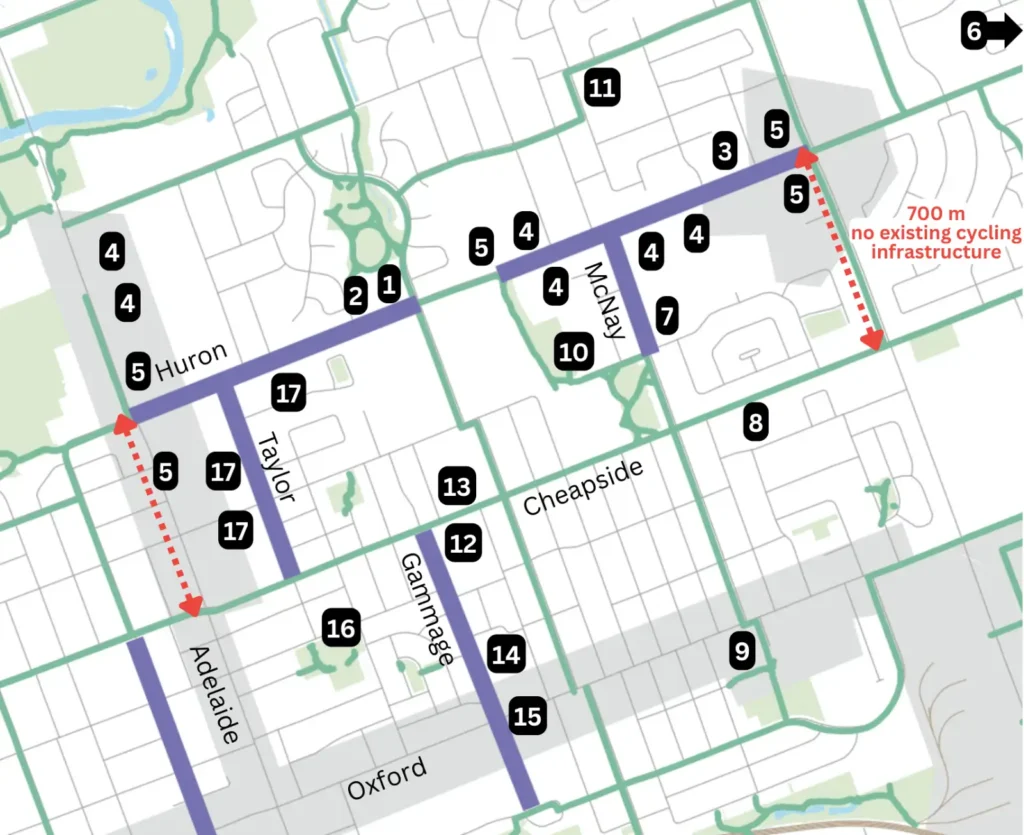
Map adapted from
MMP Cycling Network
Plan and Proposed
Revisions, page 20 of
Here are the three main points they make:
- Cheapside Street is not a viable substitute for keeping cyclists safe on Huron Street
- Budget pressure associated with these cycling network improvements is overstated
- Making cycling accessible for daily trips is consistent with London’s mode share target
1. Cheapside Street is not a viable substitute for keeping cyclists safe on Huron Street
At the SPPC meeting, Councillors Cuddy and Stevenson made various claims to support the deletion of cycling network improvements on these streets.
Councillor Cuddy insisted that the Huron Street improvement is redundant because cyclists can simply move south by one street to a parallel node along Cheapside Street. However, Huron and Cheapside are actually two blocks apart (with Victoria Street in the middle); reaching Cheapside from Huron on the west end requires cyclists to climb 700 meters up a hill along Adelaide Street.
Adelaide is notoriously dangerous for cyclists and vehicles to share lanes and experiences congestion daily between Huron and Cheapside.
Where Cheapside meets Highbury Avenue in the east, there are no cycling lanes running north-south on Highbury to Huron.
Furthermore, destinations listed above along Huron Street between Adelaide and Highbury are not accessible from Cheapside.
Citing that he rides a bike in the area, Councillor Cuddy claimed the following:
- Huron Street is “very dangerous” which is why he avoids it on his bike, and
- adding a lane for cyclists on Huron would not be feasible or safe for pedestrians and cyclists, contradicting the recommendation of the city’s engineers and planners who proposed the project.
We are unaware of the rationale for this position and would encourage Council to refer to the MMP team for their expert opinion on this proposed cycling network addition.
What about residents using bicycles who cannot avoid Huron Street because it is where they live, work, shop, attend community programs or go to school?
Including these network improvements in the Master Plan would still allow for the City to carry out further studies, if deemed necessary, prior to funding approval and construction.
On the contrary, based on scientific evidence and our residents’ lived experiences, streets in our neighbourhoods are made more dangerous for network users when cyclists and vehicular traffic are combined.
Our neighbourhood streets regularly experience drivers speeding and cutting through during peak hours, including around schools.
There have been numerous vehicular collisions associated with speeding, most recently along McNay Street (just south of where a cycling network addition was proposed) right in front of an elementary school.
Imagine if the collision on McNay Street had occurred when a cyclist was on the street and forced to share a lane with the pickup truck involved.
2. Budget pressure associated with these cycling network improvements is overstated
Councillor Stevenson suggested that recent increases in property taxes create an imperative for Council to reduce expenditures by removing potentially life-saving cycling network enhancements from the MMP maps of projects to be built by 2050.
At no point were the actual costs of these particular cycling network improvements discussed before the committee voted to remove them.
However, in the previous discussion at SPPC, the councillor expressed support for an estimated $400,000,000 expansion for Wonderland Road to accommodate 6 lanes of vehicular traffic and save drivers roughly 2 minutes off their commute while doubling transit trip length, and to establish a taxpayer-funded ring road around the City — a project that was historically deemed to be too expensive.
In terms of the MMP maps as a whole, planned investments in road enhancements to support vehicles (1.6 to 1.7 billion dollars ) outweigh investments in cycling infrastructure ($180-200 million) by a factor of nearly 10 to 1.
Again, this is an equity issue; ongoing property taxpayer subsidy of cars as a mode far exceeds the relatively modest investments planned to facilitate safer cycling.
3. Making cycling accessible for daily trips is consistent with London’s mode share target
At the SPPC meeting, references were made to Londoners being “creatures of habit” and tending to rely on modes of transportation that they are familiar and comfortable with.
Therefore, it is important to note that drivers, cyclists, and transit riders are NOT mutually exclusive categories of people.
Indeed, each resident gets to make choices every day as to how they wish to move around our neighbourhoods.
The relative appeal of different options depends on the availability and design of infrastructure providing convenience, comfort, and safety.
If the City of London plans to achieve the mode share target approved by Council, then City Council needs to create the conditions necessary to support residents shifting their habits.
FORCING people who ride bicycles to share lanes with drivers, or to pedal further during their daily trips to access safer mobility infrastructure, makes EVERYONE less safe and disincentivizes Londoners from leaving their car at home—which only adds to traffic congestion.
The Old North East Neighbourhood Association calls on their representatives for Ward 3 and Ward 4 and all of City Council to plan the future of mobility in our neighbourhoods by listening to subject matter experts and prioritizing the needs of the most vulnerable members of our communities.
Disclaimer
Oh, and one more thing:
I hold no ill will towards the counselors of wards 3 and 4. This IS NOT about their personalities or likability or anything like that. I am NOT attacking anyone’s character.
No, this is about them not doing the job FOR the people they serve and needlessly putting peoples’ lives on the line. If they are not serving their constituents, then unfortunately, as much as it pains me to do this, they need to be called out and be held accountable. THAT is what comes along with being an elected public official.
Leave a Reply