Ben’s Campaign Platform

Ben Durham’s Platform
for Ward 3
I’ve been knocking on doors and talking with thousands of residents all across Ward 3 since May 1st and jotting down everyone’s concerns.
This Platform’s four main pillars haven’t changed, but the actionable sub-goals have been updated steadily to reflect the amazing conversations and ideas of residents who have taken the time to talk with me and my campaign volunteers at the doors.
Smarter Traffic, Safer Streets
We already have solutions to fix traffic, so let’s fast-track them.
Fiscal Responsibility
Identify the leaks and stop wasting money so we can spend it where it matters most.
Tackle Homelessness Now
Neighbours are falling through the cracks. We need a better way to help them without over-taxing you.
Better City Communications
Clear talk from our leaders, so you hear about changes before they happen.
Like what you see?
Note: I’m continuing to add more to these sub-items throughout the campaign, so stop by every week or so to see the platform evolve!
Smarter Traffic, Safer Streets
The majority of residents in Ward 3 mention traffic and road-safety related issues as a major concern.
It’s frustrating, dangerous, inefficient, and costs everyone time and money.
But we can work towards the many attainable solutions to Londoners’ woes.
If elected on October 26th, I will…
Being stuck in traffic or waiting at red lights when there’s no cross-traffic is unacceptable. It’s 2026 and we really can do better.
If elected, I will push these five main solutions to improve traffic flow:
Road Work Coordination (operational)
Coordinate construction schedules more effectively, especially along parallel routes. By synchronizing work schedules across city departments, construction companies, and vendors, we can ensure that road improvements happen in high-intensity phases.
Off-Peak Construction (strategic)
Implement “second shift” requirements for critical main arteries (such as Highbury Ave, Fanshawe Pk Rd, Sunningdale Rd, and Clarke Rd). By shifting work to evenings or early mornings, we can minimize economic impacts, accelerate project completion, and improve worker safety and productivity during the hot summer months.
Smart Lights (short-term)
Update traffic lights with smarter software in 2027 and 2028 using current embedded hardware (no tearing up pavement). When there’s no cross-traffic, lights should change quickly and frequently so people don’t have to slam on their brakes or interrupt their trip and wait minutes for nothing.
Clearer Signals (medium-term)
It’s frustrating to always be wondering if traffic lights know we’re waiting at intersections. Simply adding an “acknowledgement light” and a longer countdown timer lets all road users know what to expect. Our streets are safer for everyone when things are predictable.
Better Designs (long-term)
Replace inefficient intersection and road designs with roundabouts (where feasible) because they prevent full stops and decrease average commute time, while actually being safer for everyone.
When roundabouts aren’t feasible, make sure we have enough left-turn lanes to keep traffic flowing.
1.2 – Improve Transit Service
When walking or biking is a difficult or unsafe choice, Londoners choose to drive (or are forced to), which just creates more traffic for all Londoners.
We need an “AAA” (All Ages and Abilities) network that is safe and enjoyable for kids, seniors, commuters, and recreation alike so that those who can (or want to) choose to leave their car at home actually can.
If elected, I’ll be committed to prioritizing the connection of our AAA network through:
Closing the Gaps
No one should have to navigate a path that starts-and-stops abruptly (just like how roads don’t stop and start abruptly), so I will work to ensure London’s Active Transportation Network is fully connected so that trips (especially locally) don’t always require a car out of necessity.
True Separation
Make sure that when closing the AAA Network’s gaps, we require physical separation between vehicles and vulnerable road users (bicycles, mobility scooters, pedestrians).
We can’t complain that “no one’s using the bike lanes!” if we’re asking risk-averse residents (like children) to ride on a painted lane (unprotected) next to high-speed traffic.
Seamless Curb Designs
The skull-rattling transitions at every intersection need to be fixed to make our streets accessible and enjoyable for everyone. Not only are smoother transitions more enjoyable, it’s important for those using mobility scooters who currently face serious hazards from uneven surfaces.
London has a 144-page, multi-million dollar, multi-year, community-vetted Mobility Master Plan (MMP) that was approved by City Council in 2025 to guide our transportation needs through to 2050.
Problem: Current Council tends to start from scratch every time a new traffic or transit decision comes up, and individual councillors often ignore the MMP based on personal preference or short-term political pressure.
Solution: Councillors need to stick to the plan and be the leaders we need them to be (not second-guess the process we all already paid for).
If elected, I will work to…
Lead by Example
If London’s City Councillors want to ignore or deviate from the MMP, they need to explain why in great detail. I’ll commit to using the MMP as my guide for every transportation vote, ensuring we’re building the future Londoners asked for (throughout years of community consultation).
Enforce MMP Alignment
Push for a formal requirement that all new transportation-related staff reports and motions brought to council must include a section explicitly stating how they align with (or deviate from) the approved MMP.
Prioritize MMP Action Items
The MMP contains a comprehensive list of interconnected strategies which must all be pushed forward for the entire plan to work throughout the following decades. The plan also includes actions that were developed to achieve specific expected results. I will advocate for budgeting and staffing to prioritize these already-approved action items over new, unplanned pet projects.
Establish a Working Group
I will support the creation of a dedicated “Mobility Master Plan Working Group” to oversee the implementation of the MMP, ensuring accountability and progress tracking.
1.5 – Bring your destinations closer to home
No free downtown parking passes for City Councillors. If everyone else pays, so should they.
If other candidates and city councillors are serious, too, then they need to be part of the solution, not part of the problem.
So, I’m committing to writing and introducing a motion that would require every city councillor (including me, if elected) to commute to City Hall using something other than a personal motor vehicle for at least 20 days per year (4 working weeks).
Other options could include walking, biking, taking transit, e-scootering, or anything else they might like to do, as long as it isn’t a personal motor vehicle (ie. car, truck) or a taxi/Uber.
If we’re serious about reducing traffic and supporting other transportation options, the people making the decisions should lead by example.
The current Traffic Calming petition process is genuinely frustrating and discouraging for residents all around London.
We need to empower our neighbours who are finding their pleas for safer streets falling on deaf ears after the City of London does a “quick 24-hour speed survey” and finds “everything to be fine and dandy,” even with numerous reported collisions and street racing. We need better from our Transportation Planning & Design department at the City of London.
And just so that everyone is aware, when you request a Traffic Calming Petition right now, the City of London provides the following letter which attempts to dissuade you and your neighbours from even trying to make your street safer in the first place, which I find repulsing:
Dear Resident, Thank you for your inquiry.
The City receives a very high volume of requests for traffic calming every year.
Traffic calming is a contentious subject and must be dealt with in a clear, concise and transparent process.
Our Traffic Calming Team follows the Council approved process to determine street eligibility for traffic calming measures.
Please be aware that of the very high volume of requests we receive for physical traffic calming measures that only a very small percentage of streets are suitable and eligible for physical traffic calming measures.
We do also have a Respect the Limit program. Londoners can remind drivers to slow down by placing a “Respect the Limit” sign on their front lawn. […]
Fiscal Responsibility
I’ll be honest: this one’s going to be difficult… and anyone who says otherwise is blatantly wrong. But over the course of a 4-year term, it’s possible to point us in the right direction.
The City of London needs to embrace the land that we already have and follow through with the intensification targets set out by The London Plan.
That’s one of the reasons I’ve pledged not to take developer donations for this campaign since day one.
See, if elected, I’ll 100% have to work with developers (as all city councillors do)… but I won’t have any hands in my pockets or biases when making decisions as one of the 15 votes on city council. I will vote for what is best for Londoners.
If elected, I will…
If elected, I would vote to keep our farmland and prevent taxpaying Londoners from subsidizing for-profit land developers.
The 2022-2026 City Council voted to expand London’s Urban Growth Boundary (UGB), and that’s an issue for every Londoner because if we can’t service what we already had within our 1996-2025 boundary, then why would we expand further?
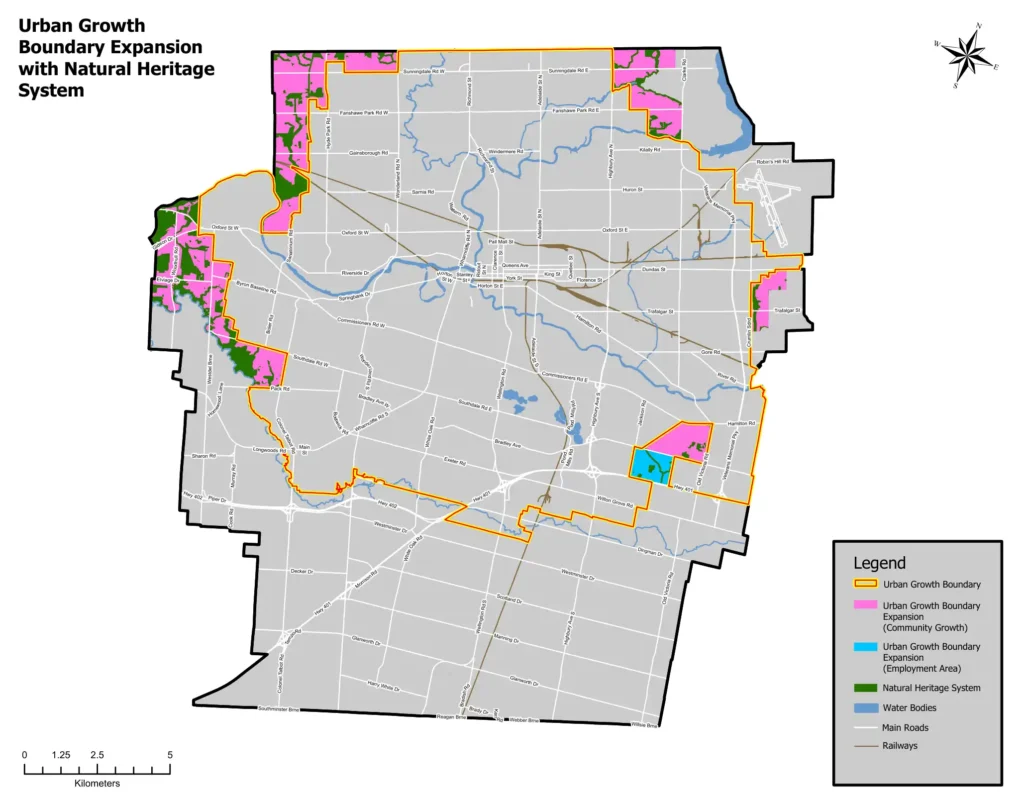
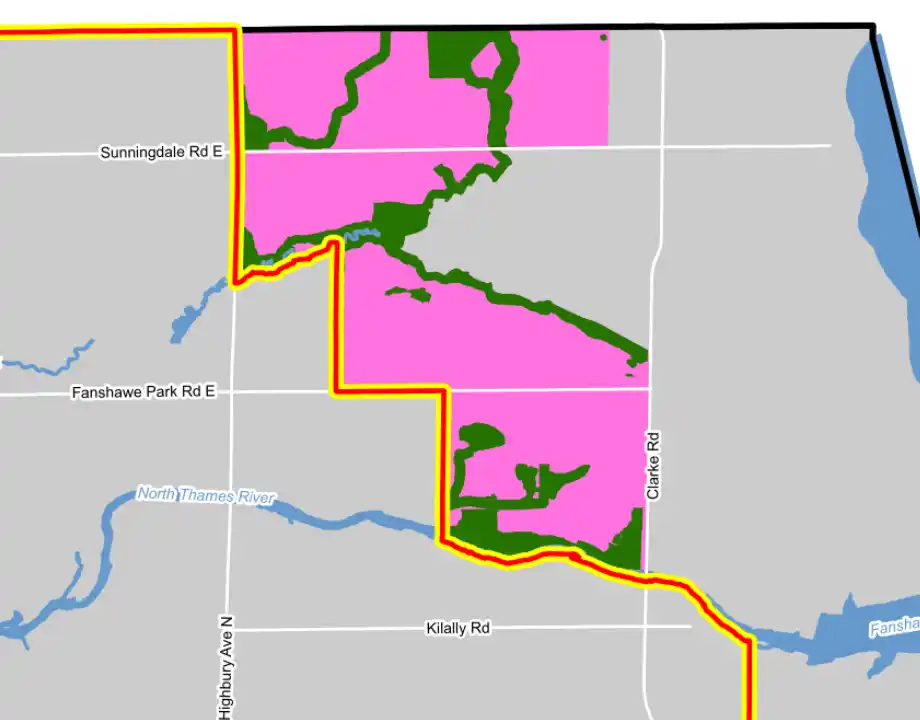
The 1996-2025 Urban Growth Boundary is shown in yellow.
The 2025 additions are shown in pink, green, and blue.
In the last few months, for-profit developers have been lobbying both Provincial and Municipal-level governments to defer their Development Charges (DCs), which pay for all the roads, infrastructure, and upgrades they need to service their new developments.
If they’re successful, Londoners will be actively subsidizing for-profit land developers. I’m against corporate handouts. Are you?
While we can’t retroactively “bring back” the original 1996-2025 UGB, the next City Council can restrict further encroachments on farmland and keep for-profit developers from milking already cash-strapped Londoners through large property tax hikes to pay for their profits.
Note: click below if you want to watch a 30-minute deep-dive from July 2025 when I, as a concerned citizen, made an extremely detailed video about our Urban Growth Boundary Expansion (before ever thinking of running for City Council).
If you’d like to learn more, check out the video below or read this blog post.
Londoners are incredibly concerned about how many trees have been cut down for new developments during the 2022-2026 council term. This isn’t just an aesthetic concern, though.
The urban tree canopy needs to be treated as the capital asset that it is, because it provides measurable economic flows and public health outcomes (aka Natural Asset Accounting).
If elected, I commit to:
Creating a robust urban forest
Investing in city trees generates a massive return on investment (ROI):
- Tree planting and maintenance yield 1.5x to 3x returns in economic benefits to Londoners
- Property values skyrocket by 3-15% compared to those without trees
- Trees save electricity by cooling neighbourhoods during the summer
- Trees absorb sound to make neighbourhoods quieter
- Trees act as natural air purifiers for our neighbourhoods
- These are just some of the benefits
By implementing both human-made interventions and natural self-managing solutions, we’ll bring down costs and prepare for London’s future.
Working with City Staff
Finances and current norms are up to City Staff to manage, so I will meet and work with them so that during the next term of council, updates to the Urban Forest Strategy will make it stronger than ever before.
Forging stronger working relationships with the many partners of the City of London who are the ones implementing solutions with boots on the ground.
Supporting more community engagement in planting and providing stewardship of trees on private and public property.
Spearheading a Municipal Tree Nursery
Reforest London’s Community Tree Nursery is a great start to decreasing our reliance on third-party commercial tree nurseries, but the scale is not there.
By creating a London-owned and operated Tree Nursery, we will control our own supply of trees (from seed to sapling) by growing them on city-owned land. Having this control will also insulate us against volatile market price hikes and allow the city to bypass retail markups (aka price-gouging due to high nationwide demand).
Locally grown, native species also save Londoners money by having higher survival rates because they are more climate-resilient and reduce the threat of non-native pests or diseases, meaning fewer dead trees that require expensive removal and re-planting.
Enhancing Engineering Solutions
Municipal infrastructure is typically seen as expensive, human-made interventions to keep our cities running through engineering feats… but we often miss a critical piece: embracing robust natural solutions that are older than the beginning of Canadian Confederation in 1867.
Insurance rates are skyrocketing in London due to ever-increasing flood risks throughout the city.
If elected, I will work with existing organizations and stakeholders to help all Londoners throughout the city save money and reduce property damage by:
Proactively Planning
It’s City Council’s responsibility to ensure development approvals aren’t creating needless and major risks for loss of life, loss of property, and environmental issues while also opening up the City to future lawsuits (that taxpayers pay for).
Instead, City Council needs to be proactively planning (not reacting) and implementing solutions with forethought to future-proof our city. Things like:
Aligning Floodplain Mapping with City Developments
Ensure all city developments and plans are in alignment with updated floodplain mapping as available, relying on a one-in-250-year storm model.
Promoting Weeping Tiles & Permeability Installations
The 2026-2030 term of council will see staff reports come back on program and policy options relating to urban flood risk… like adding the cost to replace an existing weeping tile system into the purchase price of a home when it is sold, and exploring options for more permeable surfaces throughout the city.
Growing London’s Rain Gardens Program
By introducing more Rain Gardens into London, we can cheaply and efficiently prevent costly floods across London by letting nature do its thing for very low one-time costs.
A bit more Rain Garden Program context, if you’re interested:
An example of a successful Rain Garden Program can be found in nearby Guelph, where in 2025, its Rain Garden Rebate Program helped residents install 28 rain gardens capable of absorbing up to 49,000 litres of stormwater.
In comparison, London’s Residential Rain Garden Program is administered by London Environmental Network (LEN), which currently turns many people away because of the massive demand for rain garden incentives.
Tall Sprawl are those shoehorned 10+ storey developments that are “plopped” right next to, let’s say, Single Family Homes. Instead, we need gentle height transitions / density gradients / step-down & step-up zoning.
This sub-item is best explained below, in my response to a resident’s email (who’s already voted for me during early voting), asking about Tall Sprawl in particular. Here was my quick response:
4-6 storeys are great! I’d say that 3-7 storeys are perfect for so many situations within Ward 3 and are very accessible from a capital investment/expense side of things for smaller developers (instead of just massive development corporations).
In other words, instead of drastic height differences that no one likes, resembling this ASCII art:
_____
| |
| |
| |
| |
| |
| |
| | /\
| | / \
| | | |
I’d like to make sure that we have something resembling the following, which contributes to neighbourhoods and adds to the communities, while actually making housing more affordable and accessible:
_____
| |
| |
| |
| |
| | | |
| | | |
| | | | | | /\
| | | | | | / \
| | | | | | | |
The solution is creating a gradual transition of density, just like I elaborate on in item 3.4 (Prioritize Missing Middle Housing). What we need is more creative housing options for more homes that are built for more people of all different stages and walks of life.
2.5 – Say no to Urban Sprawl in Ward 3
2.6 – Demystify city finances
As we’ve seen within the 2022-2026 term of City Council, the current process for reviewing the police budget happens too late in the cycle so that by the time the public is invited to speak (even with massive community interest), almost everything is already set in stone.
This has meant the opportunity for actual, meaningful change is lost. So, a system that moves from reaction to proactive planning is needed in London.
If elected, I will push for three changes to make sure our community’s priorities are heard before decisions are set in stone:
Draft Review Period (Early Engagement)
Instead of a single public hearing in the fall when the budget is finished, I will advocate for a “Draft Review” phase in the Spring and Summer.
This means Londoners will be able to provide their input while the budget is still being drafted, ensuring that the final version reflects Londoners’ needs.
Community Advisory Committee (Ongoing Input)
I will support the creation of a standing Public Safety Community Advisory Committee.
Members (volunteers) of this group would meet regularly with police leadership and city staff throughout the year to discuss priorities. And by having a consistent seat at the table, communities all across London will have a voice remains a constant factor in the planning process, not just a one-time comment at a public hearing.
Strategic Alignment (Fiscal Accountability)
We must stop the “over-budgeting” on non-essential equipment. During the 2022-2026 term, significant funds were diverted toward heavy tactical equipment and specialized vehicles that do not serve the daily needs of our community. These “luxury” additions have contributed directly to the Property Tax Spikes that we are all feeling while also causing slashes to other community services (which help prevent crime in the first place).
I will push for a “Necessity Audit” to ensure police spending is focused on community-based safety and local response instead of on high-cost equipment that drives up our tax bills.
I support a temporary moratorium on new AI datacentre approvals until a robust, localized regulatory framework is established.
We need to prioritize and protect everyday Londoners from the rapid expansion of mega-corporations (whose internal mottos are often “move fast and break things”) and their projects that offer very few municipal benefits to Londoners while, at the same time, strain our resources, infrastructure, budgets, public health, and environment.
AI-specific datacentres use 10 times more resources than “standard datacentres,” and provide very few jobs after initial construction (of which, non-local agencies and contractors are hired instead of London-based companies) so this is an important issue that the next council term may need to make decisions on, on behalf of Londoners.
I have much more to say about this topic, and you can read more about that by clicking here.
Tackle Homelessness Now
There are three categories that Londoners fall into:
- Affluent (homeowners/renters who are doing just fine)
- Getting by (homeowners/renters who are facing affordability pressures)
- Homeless (people who have fallen through cracks in the system and are homeless)
My realistic focus at a municipal level in this section is on the Getting by and Homeless categories.
Simply put, we need to:
- prevent people who are just Getting by from becoming Homeless, and
- elevate people who are Homeless to the Getting by category
This is what can be done…
3.1 – Stop people from becoming homeless
The most cost-effective and clearest objective here is to get Londoners off the streets and into stable, permanent housing.
The “Housing First” model is the global standard that works for moving people from the “Homeless” category to the “Getting by” category.
If elected, I would support:
Building more supportive housing faster (medium-term)
Invest in housing with highly supportive wrap-around services that stabilize people with complex needs.
After people have a stable home, they can then access the support systems (like rent banks, mental health support, addiction support, job training, financial advice, guidance) to maintain that housing and eventually move to regular housing.
Doing this saves all Londoners money in the long term and gets people off the streets.
Note: London can tap into the aggressive federal and provincial housing funding programs, to reduce the burden Londoners’ property taxes.
Proactively preparing homeless winter shelters (seasonal)
Like clockwork, winter predictably comes and goes but is routinely forgotten about by City Council until the 11th hour.
Realistically, there will always be those who need a warm place to stay because they have slipped through the cracks in our systems. So, we need to prepare emergency shelters and warming centres throughout London as a necessary safety net until more permanent housing is built.
Supporting continued outreach & navigation programs (ongoing)
Until more supportive and permanent housing is built, mobile outreach teams will continue to be needed to engage with people who are experiencing homelessness to connect them to emergency services and get them into the housing pipeline.
Note: once in the housing pipeline, waitlists are around the 10-year mark right now, which is why the other goals (ie.build more supportive housing faster) are so important.
Homelessness is not “just a London problem”, so we shouldn’t be “trying to solve homelessness” in isolation (ie. each city and town on its own), especially when the majority of cracks in our systems are at higher levels of government (ie. Provincial & Federal).
If elected, I would run to be on the board of the Association of Municipalities of Ontario (AMO) to fight for systemic changes in how higher levels of government choose to “solve homelessness”, which directly affects how municipalities tackle numerous problems.
Unpredictable funding results in very short-term planning, which is wasting millions of taxpayers’ dollars
As you might know, when you’re either running a business or making a household budget work, predictable funding is incredibly important for stability (and, ideally, optimization).
But right now aid organizations across London (and Ontario) have been left to use Band-Aids to patch the Titanic (aka the multifaceted system-level problems of our time).
If we expect to “see results” from these front-line organizations that actually can save us all money in the long-run, we need to think long-term. Because if the organizations themselves are also actively in survival mode (as they help those who are just surviving, too), how can you expect them to implement efficient long-term planning, when they don’t know if they’ll even have funding two weeks out?
This is where higher levels of government can assist with both solutions and funding so that ground-level organizations can focus on implementation.
A quick blurb about AMO
AMO works to make municipal governments stronger and more effective. Through AMO, Ontario’s 444 municipalities work together to achieve shared goals and meet common challenges.Through AMO’s policy development, cost-saving programs, conferences and training opportunities, it provides municipal officials with tools to succeed, and programs to help maximize taxpayer dollars.
If elected, I will advocate for more creative housing options to get more homes built for more people of all different stages and walks of life.
As discussed in platform item 2.1 (stop spreading London’s money too thinly), if London continues to sprawl, it will:
- increase traffic
- increase our property taxes
- pave over some of the most fertile farmland in the world
So, for everyone’s sake, we can’t continue to sprawl our city outwards.
Luckily, there are many ways to gently increase social connections and affordability without having the extremes of ultra-low-density 5000 sqft McMansions (unaffordable for most families) or towering “shoeboxes in the sky” apartment buildings (too small for most families).
“Missing Middle Housing” includes:
- Duplexes
- Triplexes
- Fourplexes
- Townhomes
- Cottage courts
- (and more)
All of which blend into single-family neighborhoods and are much less expensive to build. And they help reignite and foster real community connections, which allows for the ground-up support that we all need as human beings.
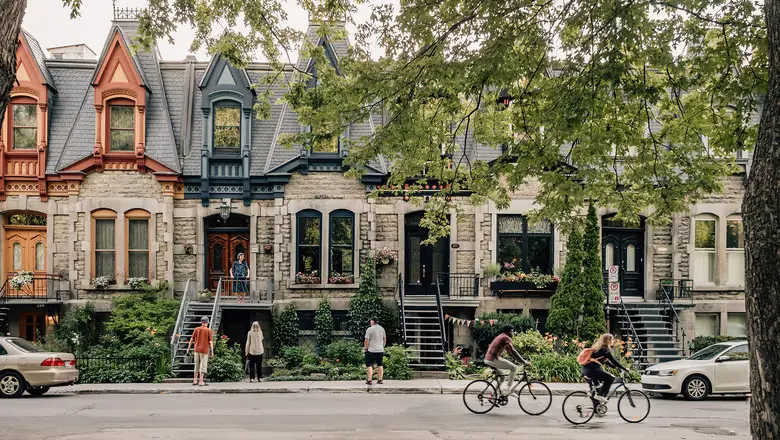
A quick example of gentle-density neighbourhoods being desirable is in Le Plateau in Montreal, which is one of the most densely populated boroughs in Canada. It achieves its density by featuring mostly low-rise, 2-to-4-storey buildings that preserve its human-scale and walkable character.
It was recently ranked as one of the Coolest Neighborhoods in the World.
The goal of the current London Plan regarding growing “inward and upward” is to focus new development within the existing urban boundary, rather than expanding outward into suburban sprawl. There is a problem, though: the plan targets an infill rate of around 45%, which means 55% of London’s development is still outward sprawl.
3.5 – Implement successful homelessness solutions (found elsewhere in the world) in London
Empty buildings can’t continue to be allowed to sit and rot for decades through Land Banking while our communities remain underserved. Ontario’s laws limit the ways we (the City of London) can tax Vacant Commercial Properties directly, but the same laws also give us the power to manage how those spaces are licensed and used.
So, if elected, I’d use that power to move things forward by committing to introducing a motion for a Mandatory Public Vacant Commercial Property Registry featuring mandatory routine audits.
This will identify:
- which buildings are sitting empty
- their current status
- any structural issues
- emergency entrances and exits
- any hazardous materials present
This is a critical safety tool for our first responders which can only exist by maintaining an accurate record of what (and who) is inside these properties. This would be a vital risk-assessment tool that would equip all our Emergency Service teams with the vital information they need to keep themselves safe while saving Londoners’ lives.
The entire cost of this program (including all legal, administrative, and staffing costs) will be funded by the owners of those Vacant Commercial Properties, not by your property taxes.
According to the hundreds of police, fire, and paramedics we talked to at the doors in Ward 3, emergency workers spend over 50% of their time (sometimes up to 70%) dealing with calls related to homeless individuals.
Many times they return to the same individuals, often for reasons that don’t warrant such expensive resources, while taking time away from other duties. Meanwhile, Emergency Rooms at our hospitals are overcrowded, with long wait times, often caused by an influx of homeless individuals desperately seeking medical assistance.
It’s important to note that the longer someone experiences homelessness, the more physical and mental ailments pile up… so by the time someone is admitted, they have a multitude of compounding issues that need tending to. Because of this, while an average hospital stay for a general population patient averages $7,800 and 8 days, a patient experiencing homelessness costs $16,800 and stays over 15 days.
If less costly care can be provided “upstream” for the homeless population (before a crisis happens), then emergency workers in London and the Emergency Rooms at our hospitals can return to providing more services to the general population.
Implementing this Pillar’s (Tackle Homelessness Now) goals are the less costly option, long-term, on all fronts.
Better City Communications
Thousands of doors knocked on and months of talking with residents about their concerns, and there is a pattern: overall frustration. Frustration about not knowing what or when things are happening in the city has been bubbling to the surface as a main concern.
Below are some ideas that have been shaped my conversations with you, the residents of Ward 3.
If elected, I will…
The vast majority of thousands of Ward 3 residents that I’ve talk to at their doors since May are frustrated when city projects (road work, construction, new developments, utility upgrades, park upgrades, etc.) lack clear communication and consistent updates. Londoners just want to know what and when is happening in their neighbourhoods and along their frequented commuting routes.
If elected, I will push for a Unified Project Coordination Initiative (UPCI) to fill the communication gap between city departments, contractors, agencies, and the public (Londoners like you).
This UPCI will include a publicly available, web-based Project Dashboard featuring a high-quality and easy-to-use User Interface and User Experience (UI/UX) to provide real-time updates on all active municipal projects. This tool will feature:
Live Project Status
Clear indicators for “Pending,” “Delayed,” “In Progress,” and “Completed” projects across all city departments and geographically across the City of London.
Interactive Mapping
A visual way for citizens to see exactly where work is occurring and how it impacts their daily lives, with the ability to “get granular” with filters, addresses, dates, times, company names, contact info, and more.
Estimated Timelines
Accurate windows for when work is expected to start and finish.
Proposed Detours
Accurate and up-to-date planned alternative routes for when work is expected to start and finish.
Delay Logs
Transparent reporting on why a project is delayed (e.g., weather, supply chain issues, or unforeseen site conditions). Logs should be kept and never deleted, as this is valuable data to have when City Staff or City Council are making (and justifying) future decisions. These logs would also allow for easier audits.
Providing this level of transparency should have been implemented long ago, but at least we can start now! We’ll be able to ensure that city departments and third-parties are better coordinated so that residents and local businesses have the information they need to plan their lives and operations effectively.
We live in 2026 and most of us, for better or worse, rely on third-party apps to navigate traffic woes of London’s project. Leaning into that reality, the following would let Londoners get incredibly accurate navigation info before they even leave their driveway, not just after they’ve already hit a detour.
Right now these non-city mapping apps rely on “crowdsourced” location data from our phones, where once enough people get stuck sitting in traffic and report construction, the map updates.
There’s a better way: I will push for the city to adopt automated data-sharing protocols with major navigation platforms.
By creating a “Source of Truth” digital feed, City Staff can automatically push official real-time (and scheduled) construction data, road closures, delays, and detour routes directly into Google Maps, Apple Maps, and Waze.
4.3 – Revamp the City of London website and service portal
4.4 – Create a centralized accountability dashboard for Londoners’ concerns
4.5 – Release a “Ben Durham Report Card” every 6 months (*at minimum)
Support Ben’s Campaign for a Better London
Help us turn these goals into action with your meaningful contribution.
Contact Ben & Co.
Call or Text: 226-582-3470
Email: ben@bendurham.ca
Campaign Team: team@bendurham.ca