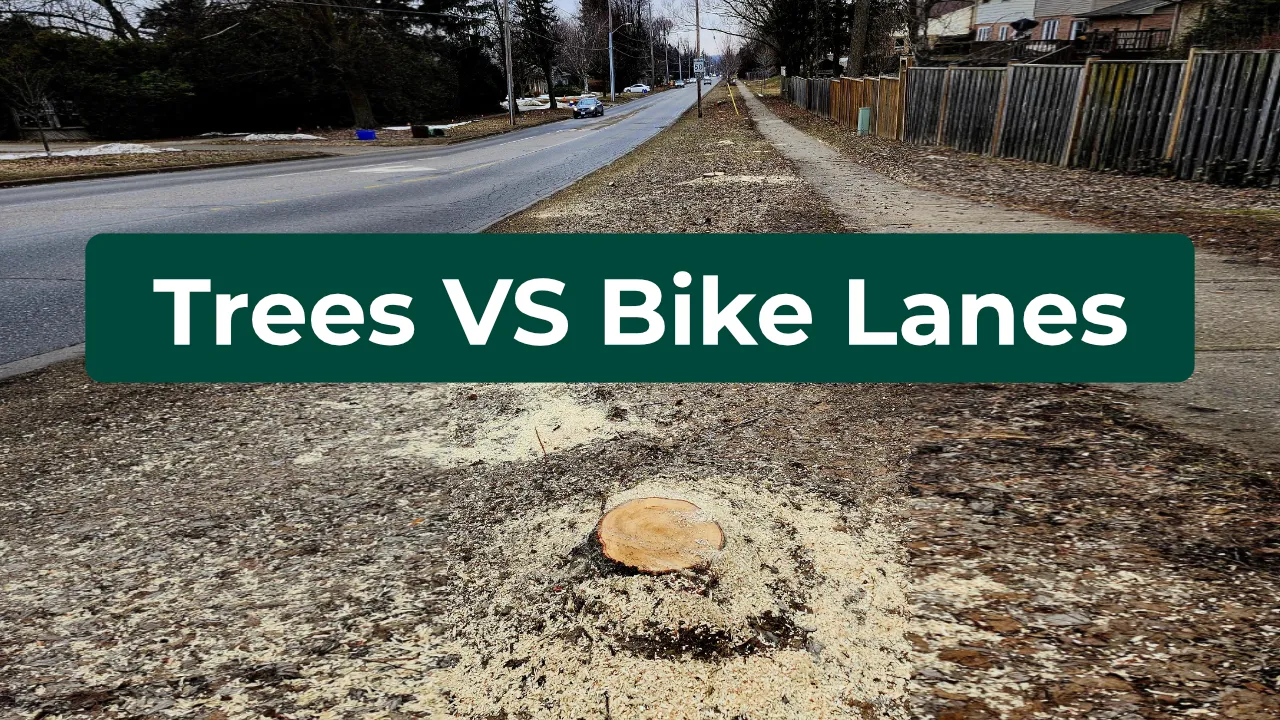
If you’ve driven down Boler Road recently, you’ve probably noticed the cleared boulevards (aka chopped town trees on the side of the road) and felt that initial gut punch.
And you probably had the same question as many other Londoners: “why’d they cut down all those perfectly healthy trees anyway?”
Listen to the full news interview here:
… or head down to the full transcript, if you want to read through it by clicking here.
Natually, a photo of the leftover stumps was posted on Reddit and caused an emotional ruckus… and to be honest, I understand why. We’re the “Forest City,” so watching mature trees come down feels like a loss, at first glance.
But as with most city-building projects, there’s a much bigger story behind the scenes and debatably bad optics of chopping down a bunch of trees.
After digging into the City of London’s plans and chatting with a reporter about it, I wanted to share a clearer picture of what’s happening, why it’s happening, and what’s happening next.
This project is more than just a bike lane
Yes, the main event is a new two-way cycle track running along the east side of Boler Road from Commissioners Road to Southdale Road. But this isn’t just about painting lines on the road (which is not a properly protected bike lane for All Ages and Abilities).
It’s a major infrastructure overhaul that also includes:
- Replacing aging watermains and water services.
- Adding two new pedestrian crossings at Optimist Park Drive and Norman Avenue.
- Upgrading traffic signals at key intersections like Griffith Street and Byron Baseline Road.
So, while the bikes are the headline, the construction zone is also addressing critical underground infrastructure that’s reaching the end of its life.
So, why did the trees have to go?
From my perspective, the heart of the issue is how the city’s detailed planning came into play and when it was conveyed to the public.
Back in 2023, the city held public meetings to discuss this project. No chainsaws were in hand. According to the official pre-construction notice, a professional arborist assessed all 211 trees within the project limits. Their job was to evaluate each tree’s health and figure out how to build the new infrastructure with as little impact as possible.
The decision came down to three main factors:
- Direct Conflict: the new, separated cycle track needs to go in the boulevard. In many spots, the existing trees were literally in the way.
- Root Systems: you can’t just pave around a mature tree and call it a day. The root systems would eventually heave and crack the new concrete path, and construction itself would damage the roots, likely killing the tree anyway.
- Health: some of the trees slated for removal were already in poor health, showing signs of disease, decay, or significant stress.
After this assessment, the hard decision was made to cut down 83 trees along Boler Rd. That’s broken down into 62 “small” trees (under 30cm in diameter) and 21 “large” trees (over 30cm).
Canopy replacement?
83 trees is a lot, but this isn’t the end of the… branch(?) for Boler Road’s canopy. The City of London has a robust tree replacement policy, and they’re already committed to it.
For every tree removed, the city has a replanting multiplication factor, especially for larger, more significant trees. The goal is to plant thousands of trees city-wide each year to mitigate climate change, provide shade, and manage stormwater. This is what their “Pre-Construction Notice” document states:
When projects are completed, the City replaces the removed trees where possible and evaluates additional new tree planting opportunities on these streets. Each project is unique, and our approach to tree replacement is tailored to the context of the area we’re working with.
Each year, the City of London plants approximately 5,000 trees to help mitigate the impacts of
climate change, provide shade and lower temperatures reducing energy costs at homes. Trees
also help absorb heavy rainfall and reduce stormwater flows.
TL;DR: once construction is complete, the city will go back to Boler Road and plant new, native species where possible. They’ll also look for additional planting opportunities along the street.
Now, this isn’t an immediate trade because a new sapling won’t provide the same shade as a 50-year-old maple for a long time… but it is, at least, a commitment to ensuring the “Forest City” lives up to its name for future generations.
My take on this: it’s an optics problem
You can read the the full transcript from the interview lower down in this article, but when Axel asked me about “balancing environmentalism with new infrastructure,” my first thought was the same as everyone’s: “Dang, that sucks.” I love our trees. My wife and I have used the city’s awesome service.london.ca tool to request hundreds of them be planted in local parks… and it works! Just takes a few months, so patience is key.
But I also know that a safe, connected cycling network is a game-changer for cities, partially because of research but also because I use London’s connected active transportation network almost every single time I leave our home!
Right now, Boler Road is a gap in that network. Kids, teens, adults, and people on mobility scooters, and more who want to get anywhere along Boler Road have to brave a dangerous road or ride illegally on the sidewalk. And, to be honest, that barrier makes it so that many of those potential journies never even happen. Because parents don’t want to put their children at risk, no matter their age.
This new lane changes all of that.
For me, the city did most things right. They followed the rules and did their assessments… then they held public meetings. But that was years ago, and that is the problem here. The problem is that two years is A LONG TIME. People move in and out of neighbourhoods, sometimes for the tree canopy, and then, months later, it’s gone.
The city’s next public meeting isn’t until March 25th, 2026, weeks after the trees are already woodchips.
That’s the optics problem. You can follow every rule and regulation, but if your final communication comes after the most visible and emotional part of the work is done, you’re going to have an angry room and angry neighbours. A quick update meeting a few weeks before the chainsaws started revving could have made all the difference.
The trees are gone, but you can still weigh in…
Want to see the plans for yourself or ask a question? The city is hosting a Public Update Meeting, in the form of a Drop-in open house.
When: Wednesday, March 25th, 2026, from 5:30 pm to 7:30 pm
Where: Byron Public Library (1295 Commissioners Road W)
That’s a chance to view the updated construction plans and talk with city staff, who are fantastic people – just like you and me.
Ask them about property impacts, road closures, utility impacts, how the bike lanes will work, and get more details in general. You can also find all the information online at getinvolved.london.ca/bikeboler.
It’s unfortunate to see those trees go. But they’re gone… and in the long run, a safer street that gets people out of their cars and connects a bunch of neighbourhoods to the rest of the city is a huge win in my books.
My hope is that in a few years, more people will be able to get out and walk and cycle down a beautiful, tree-lined Boler Road, with the new canopy providing shade for everyone. Just gotta water those trees when you can to help them out.
Support & Vote for Ben Durham in Ward 3
If you’ve read this far, I’m glad I could help you understand things more!
I’m Ben Durham and I’m running to be your next Ward 3 City Councillor. I live here in Ward 3 and have been advocating for our neighbours for years.
This is the kind of work I’ll bring to City Council: digging into the details, talking to residents, getting real answers for the concerns that affect your everyday life, and voting for a better London.
On October 26, I’m asking for your vote. You can also vote on one of the 8 other early voting dates in October!
Learn More About My Platform →
Full transcript of the interview
So, this whole article came about because a reporter (Axel Statler) reached out to me the other day and asked me about my thoughts on how the City of London is moving forward with its plan to cut down 83 mature trees along Boler Rd, here in London, Ontario, Canada – aka the Forest City. Here’s how it went; you can either listen to the link below or read through the (lightly modified) transcript below.
Listen to the full news interview here:
Axel Statler:
Hey, Ben, how are you?
Ben Durham:
Pretty good, you?
Axel Statler:
Doing okay, thanks. All right. With me today is Ben Durham. Thanks for joining me.
Ben Durham:
Yeah, no problem!
Axel Statler:
Now for, for people that don’t know, could you get into, I guess who you are and what you do?
Ben Durham:
So I’m a video producer here in London, Ontario, and over the last few years, I’ve gone fairly heavily involved in- I would call it municipal politics, but a lot of it is urbanism and safer streets for people, really, and better ways to get around cities. Because as you can tell, if you’ve ever driven through Toronto on the 401, no number of lane widenings will help ease traffic congestion. Only viable, reliable, other options, and preferably affordable as well, options that are not personal vehicles, are the way forward to get out of the traffic problem and road safety problems that we are experiencing globally, but especially here in North America.
Axel Statler:
Now, we know that London is expanding with their, I guess, with their transit and their infrastructure. The main reason over here I wanted to talk was because there’s a new project going on in London on Boler Road. And the main concern that I’m seeing is – based on what I’ve seen online – is the, I guess the trees being cut down for the cycling infrastructure. What’s your take on that?
Ben Durham:
So I saw this post. It was a few days ago, I think about a week ago, and my first thought was, “oh, that’s sad.” I think that’s everyone’s first thought.
I actually really like service.london.ca. If you ever have any problems or want to even get trees planted, I think, my wife and I have planted hundreds of trees because we’ve just requested them. Takes a few months, but they get planted, and so we have parks that didn’t have trees before and: BOOM! Within six months, now they have a bunch of trees planted along, sidewalks and this and that.
And the reason I’m bringing all of that up is: shade is important. And the cooling effects of trees are really important. So that was my first thought when I saw this was, “dang… when there’s a bike lane going in and we have summer coming up – and it’s going to be a hot one apparently – that’s going to suck.”
But also what sucks more is that there is no bike lane there right now. And so the connectivity of active transportation networks… there’s a huge amount of, well, huge gaps. Even small gaps can be the difference between people choosing to hop on a bike to go do things or not at all. Or never even considering even picking up a bicycle for either their kids or themselves and being like, “no, it’s too dangerous!” There’s no place to get to, in this case, like Springfield Trail, etcetera, so…
Axel Statler:
How do you teeter that line between, I guess, environmentalism and, you know, ways to get around the city a lot more clean or efficient with, okay, the trees are being cut down, but we’re going to have bike lanes to move people around… How do you balance that?
Ben Durham:
For sure. So I actually reached out to the city and I did hear back. And I’ll just read what they had to say real quick. And it’s specifically about “how many trees were removed” and “are there plans to plant replacement ones once construction is complete?” And so this is verbatim, the words here:
Trees within the project limits were inspected by a professional arborist from the project team to assess their health, review potential construction conflicts, and develop a tree protection plan.
A total of 211 trees were assessed within the project limits. Of those, removal is required for 62 small trees (so the 62 small trees are less than 30 centimeters in diameter) and then 21 large trees (which are more than 30 centimeters in diameter) on Boler Road. And then when the project is complete, the city will replace removed trees where possible and evaluate additional tree planting opportunities along Boler Road.
Then they go on about how the City of London also plants approximately 5,000 trees to help mitigate the impacts of construction, provide shade, and absorb rainfall, and improve streetscapes.
So, that was the kind of the city official statement there. Could you repeat the question? Because I have my thoughts. I just wanted to kind of get that out there, so we have all the numbers.
Axel Statler:
No, 100% for sure. My question was, how do you balance that environmentalism with infrastructure for cycling because it kind of goes hand in hand with building, I guess, cleaner cities, ways to get around a lot better, but you also want to have, I guess, you don’t want nature at the same time, too.
Ben Durham:
Yeah, and it’s tough-
Axel Statler:
Or As little as possible anyway.
Ben Durham:
Exactly! It’s tough because… The other thing on my mind – and I think on a lot of people’s minds – when they saw this image, they looked at it and they’re like, “okay, a two lane road,” so one direction each way for vehicles, and “would this be such a big deal if”… like, “would this person have taken the photos and posted them if it were for lane widening [for cars]?”
So going from two lanes to four lanes. And my thought is “No.”
I don’t think people take- they’re less affronted when it’s for lane widenings which are drastically worse for so many reasons including that they just don’t solve traffic problems at all. You might have the temporary first few months where you’re “like WOW! There’s so much capacity here!”
But that’s what it is: capacity. In that it holds vehicles while they wait at the bottleneck that is inivitable. So like, it doesn’t help, because just down the road, it’s two lanes still. So it doesn’t matter if you loosen your belt if you’re still eating unhealthily every single day and not choosing other options.
And I’m not even saying- So, okay, yes, the trees being gone, especially the mature ones. That’s- *sigh* that’s that’s the really unfortunate bit. I would love to see some creativity or maybe more creativity from the engineering department and maybe having the, I don’t know, bike lanes go around the trees? But then you have the root problems, where they- you put in- you put it in all the concrete, and then you have problems of the heaving, where the roots just destroy what was there anyways.
So they probably thought about this. I’m not an engineer. And so I think do try to mitigate whenever they can. They don’t want to be mowing down trees. I know that to be true. And in this case, it’s an optics thing, so I have my thoughts on that… You can ask your next question though!
*laughing because I got rambling and I know Axel has his questions to ask me*
Axel Statler:
No, fair enough. Now, do you think- I mean this is just one stretch of road that we’re talking about over here, but: do you think this will change how people choose to get around the city at all?
Ben Durham:
For sure. So when people are deciding how to get around the city of London, it might start when they’re young. Or they might move here when they’re older. Or- tons of people- there are people who have retired here specifically because of the bike network, actually! From- I know a few people who have come from cities in the US in previous years to retire here in London, Ontario (of all places) because of the bike network. And for a lot of people, they might be like, “whoa, really?” Yeah, that actually happens and is actively happening. So-
Axel Statler:
I’m a bit surprised by that too, yeah.
Ben Durham:
Yeah, I hear those stories, I’m like “whoa!” because London, Ontario, Canada is not necessarily on the map for everyone. London, England? Of course! I don’t know if you’d retire there, either but anyways…
So, yes, when you have a connected grid just like if you decide “I’m going to drive today” which is a whole decision where are growing up and you are biking everywhere and then you let’s say go to university or college, depending on whether it’s in this city or another city or abroad, depending on the public transportation options, etc. Or if you go south of the border, you may have to get a car, but a lot of the cities that attract post-secondary students actually have what is kind of like a really walkable area.
And so a lot of people can get away without owning a vehicle because that’s a huge cost. And right now, as you and I are talking, gas prices are skyrocketing, right? So it’s not just-
Axel Statler:
Haha don’t get me started on that.
Ben Durham:
Exactly. And so when we say, “oh, well, what about the impact of cutting down – in this case, it’s a significant amount of trees, for sure. I’m not saying that that’s- I don’t know, 211 trees.
[ correction because I misspoke during the interview: 211 were accessed, removal is required for a total of 83 trees; aka 62 small trees and 21 large trees. ]
That’s unfortunate for sure- and then this morning, a massive oil tanker blows up and that’s about the carbon emissions of the entire population of planet Earth in an entire year, but in one hour. So, uh, a few trees- scheme of things, grand scale of things.
It’s unfortunate, but getting people out of their vehicles and, one, not supporting oil as much, I realize there’s diesel and everyone needs to get their goods and services but everyone who can or wants to get around outside of a vehicle, whether those are kids or parents not wanting to chauffeur their kids and say, hey, Billy, hey, Jamie, just head over to the school on your own, because guess what? There’s a bike lane now. That is all made possible by connected infrastructure without gaps. So really closing that connection- the connectivity gap and reducing car dependency is what this is all about.
Axel Statler:
How about those people that’ll say, “you know what? I still wanna drive. I don’t wanna take my bike anywhere. I’ll just buy an EV (Electric Vehicle)”?
Ben Durham:
Exactly. No, it’s totally also a thing. It’s just that those use extraordinary amounts of resources as well, and they don’t alleviate traffic. So if you wanna continue driving, you should definitely be pro bike lane because guess what?
Isn’t it annoying when you have a slower vehicle, so a person on a bicycle, in front of you? And they don’t have anywhere to go- and you’re like, “why are they on the road- ohhhh…
They’re on the road because there is a sidewalk which they are legally not allowed to be on, and two, it’s dangerous because at intersections, drivers are not looking when they are making turns and don’t expect a moderate-to-high-speed vehicle on a sidewalk entering an intersection. So that’s the right hooks and left hooks hooks are very, very common, unfortunately.
And suddenly it’s actually better for traffic because you have the reverse impact, the opposite of induced traffic, which means just fewer people in cars.
Axel Statler:
The city is growing quickly. Do you think London is keeping up with that growth?
Ben Durham:
I find it funny that council previously voted against BRT (Bus Rapid Transit) routes in the West and North leg, and now they’re like “wait, wait, wait, wait, wait, wait, we hear you loud and clear! We actually want the West leg!”
However, plans have already moved along when it comes to the East and South BRT routes and things take a lot of time, but people are sitting in traffic, especially in the Northwest [of the city] where the urban growth boundary has been expanded and council has said, “yes, we want that! We can’t sustain what we have, but we want more land so that property taxes will go up!”
So yes, they’re expanding the BRT and I’m hoping active transportation is not too forgotten about in the northwest side of the city. In this case, it’s the southwest part of the city, which also has huge amounts of sprawl. And this is just one of those projects that need be done. I don’t like how it had to take out trees and… I my thoughts on optics, but that can be for your next question potentially, I’m not sure.
Axel Statler:
Well, I was going to lead into- I actually spoke, just a few hours ago, with [city] Councillor Hopkins, I got her on the phone and she much went over what the project was going to be about and, you know, how the trees, I guess, have to be taken down apparently before April 1st. So, you know, I guess, can the migration of birds.
And this whole process started about a year and a half ago to two years ago, where they set up public meetings. And there is actually another one on March 25th [2026] at the Byron Library. So that’s coming up and it’s coming up soon. Where people can, I guess, voice their opinion.
Ben Durham:
Yes.
Axel Statler:
Right. So we just went over pretty much all of that and why it was a necessity for this to get done. And also, she did mention that there will be, I guess, water main repairs during this time, which could lead into had to be removed. Now, if you wanted to follow that up, could you say the last part of your question again, just so I don’t get lost?
Ben Durham:
I’d call it optics and communication, could be another phase of your article, your write-up. But I can kind of dive into it unless you wanted to query me.
But the optics and communication of the city is, I think, what’s happening here- or the lack of planning. And there are just few fixes that I would make.
Axel Statler:
Do you think, I guess, City Council could have been more clear to the public? I mean, what you would make or you would like to see be made?
Ben Durham:
Two years ago, they had community consultation. Two years is a long time. So I think this is an optics problem. And no matter if they did, which I think they did, everything legally right and they did all the processes, that have to be done. That’s great! Good. Good job. I’m glad that the rules were followed.
The problem is two years is a long time and someone could have just moved in like four months ago, two months ago… and they’re like “wow we moved here because of the trees, I really like this” and then two months later, BOOM! They’re cut down. It’s like, “whoa whoa whoa! What happened?!”
City’s like, “well, don’t worry we consulted you two years ago!”
It’s like, “what?! I didn’t even live in London two years ago- I just got here!” So that’s a possibility but even for those who lived there for, let’s say, the last 30 years… they have grown up they’ve seen the trees grow. And even if they had to go, and this is the thing, even if they did have to go: two years, long time, it was posted online, there was a community event, and that’s all good, BUT… here you have, as you said, March 25th, there’s another community meeting. It doesn’t matter if all the rules were followed, all the laws, etc. It doesn’t matter, because on that day, there’s going to be a kerfuffle and people are going to be irate and show up mad. I’m hoping they have some sort of understanding, I really don’t want it to get heated. I hope it doesn’t. But it just might.
And that possibility just means that there should have been a consultation before such a drastic measure like mowing down 211 trees [misspoke: 83 trees, still!] from a very busy road that were very, very, very visible to everyone, and cherished… that should have – if it was going to happen anyways – there should have been another meeting after the [meeting] TWO YEARS AGO ago that they had it… have another one, let’s say a few weeks prior or even a week prior to this happening [the trees being cut down] and saying “hey this is why it needs to happen. We consulted two years ago but it’s been a while. We set up this time and we posted on all of the different social medias, and kind of irronically we made maybe printed out, on paper (which is trees) and put all these notices in the mail… and this is happening.”
Now, people could have then spoke out and been very annoyed, but at least it wouldn’t have been a surprise because now on the 25th, you- the time of events is really kind of entertaining in my mind.
Axel Statler:
It’s very close.
Ben Durham:
Around let’s say the 1st for March. So about a week ago, the trees got mowed down. And TWO YEARS prior to that, that’s when it was established that, “hey, we have community consultation time.” Two years, again, a long time. And then two weeks from now, just about 13 days, on the 25th, “people are going to show up and be like, what the heck?! We weren’t consulted!”
And the city will say, “but we consulted you… two years ago.”
So really, it should have just been that mid-February, or late-February [where] there was another consultation meeting instead of after the doozy.
Axel Statler:
So it’s essentially like saying… know we did the bare minimum we communicated it’s just we didn’t do it at the time that everybody else liked.
Ben Durham:
It’s that they did actually do a good job communicating… when they did – which was two years ago.
The problem is that just… the recency. It wasn’t there, so I really just think it’s the the frequency and the having it sooner or more recent. So, “hey all of the processes were followed we’ve done everything all of the assessments here’s the update. We are about to remove a bunch of trees and this is why.”
And then you wouldn’t have this post. You may actually have this post, let’s say on Reddit or other community forums. And better understandings of what’s what’s happening in the neighborhood and why, really.
Axel Statler:
100%. That leads me into the final few questions that I have over here. Now, I saw online, on your Instagram page, actually, that you might be running for Ward 3. Is that correct?
Ben Durham:
*chuckling because I didn’t expect this question during this interview*
Fun times. What I can legally say is I am definitely thinking about running in Ward 3.
Axel Statler:
Thinking about it, yes, yeah.
Ben Durham:
I am thinking of running in Ward 3 for City Council because in the last few years, I have gotten more and more involved. I’m on the Old Northeast Neighborhood Association board, and we’re just really involved, my wife and I. And I think it’s potentially the right time… Yeah, to dive in.
Axel Statler:
So let’s say, for example, if this all did come to fruition, that would be, I guess, your top priorities in that area?
Ben Durham:
And that’s the fun thing is: I have started door knocking. I have to find a better way to be quicker because I have such deep with my neighbours that I’m getting through maybe 10 houses in two hours! We get TALKING.
And it’s interesting, a lot of people have similar… I’m not going to say complaints, I’m not going to say issues, but concerns. And sure, Huron Street is actually similar to Boler Road. It’s that if you go onto my socials or go onto YouTube in the past, I have fought for just the possibility of the bike lane being removed – there is no bike lane on here on the street right now, but there was a misunderstanding and they were, uh, council, including, uh, Ward 3’s current councillor was voting to remove that from the plans for medium term plans. And I think living in the Ward [3], which I do, I think we have the lived experience of living here and we know how we navigate through the neighbourhoods and how other people navigate and use the streets and roads and the amenities that we have in our area and in the Ward.
Axel Statler:
Now, I did have a look at your YouTube channel as well, too, alnd you’ve done, I guess one of the things over here is a bike with David Ferreira in one of your recent [videos]. Who’s the next person you’re going to be riding a bike with this coming summer?
Ben Durham:
So I have a whole- editing video editing is what I do professionally. So of the paid work and other things like that, aside from YouTube, are what I focus a lot of my time on. And so I have a few that I have I’ve done and I have not yet edited. I should really get those out.
But they’re not only with counsellors, but [with] other, I would call regular civilians, other residents of London, Ontario, [recorded] throughout all of London. And I know that you’re bringing this up, I should really put those out before things get a little bit more busy for me in the coming months.
But London Cycle Link, which is an organization, actually a charity now as well! And they are advocates for cycling in London, getting more people on more bikes. And they are – just like the last election – going to be hosting rides for candidates.
Which I am not right now, because is no campaign, there’s no registration… I am thinking of it.
I mean I’m very thinking hard about it but legally still just thinking about it. Anyway, they [London Cycle Link] do ride-alongs and I do the filming typically, because that’s I do, and my specialty is I can film while holding heavy gear and stabilizing it whilst also riding a bike. So that was… it’s a lot.
But anyways, so hopefully all of the candidates get interviewed. Now, I don’t know where that’s going to fit in my schedule if I’m the one filming and I’ve tried – not contracting it out – but I’ve tried getting other people to do the filming and it is… difficult, we’ll call it. I did not realize how much skill it takes.
Axel Statler:
Fair enough. Fair enough. I mean, we’ve got a lot good students in the video program and journalism program at Fanshawe?
Ben Durham:
I might need to connect with you and those students because-
Axel Statler:
Yeah, for sure. We can speak about that after, but-
Ben Durham:
Yeah, we can get cargo bikes going and that makes it a little bit easier. So you can sit backwards or on the front and then one person can focus on riding a bicycle and the other can focus on filming, which is how the David Ferreira episode happened!
Axel Statler:
It’s pretty neat. Pretty neat.
Ben Durham:
I’d say so. It’s quite fun.
Axel Statler:
Now Ben, where can people find you?
Axel Statler:
So I’m going to be centralizing everything on BenDurham.ca. And otherwise you can look up Ben Durham on YouTube and TikTok and Instagram. I have taken a little bit of a hiatus- I took a little bit of time off from the interwebs, but I am now building out BenDurham.ca behind the scenes. You’ll not see too many changes right now, but that’s for the upcoming campaign… that may or may not happen because I’m only thinking about running.
Axel Statler:
It’s just up in the ether.
Ben Durham:
Exactly yes, yes
Axel Statler:
Awesome. Well, thanks for joining me today and hopefully we get to connect down the line and we’ll go from there.
Ben Durham:
Yeah, for sure. I guess just to wrap up with the the Boler Road, I think I said this already, but I’ll say it as maybe more of a soundbite here: which is I think it’s more of an optics problem than an actual structural problem, because the trees in this case, they worked around what they could, but the road narrowed too much and there’s not enough room to be able to do what they needed to do, so the trees were coming down.
It’s unfortunate. I think one thing they could do at the presentation coming up on the 25th is say, “hey, here are approximate sites for new trees, and this is what we potentially. No promisees because that can’t be promised right now.”
But I think a [presentation] slide saying, “hey, this is where we’re thinking of putting trees and how it might look.” They might not be able to have mock-ups just yet, but I think that would be really clever of them.
But yeah, you can follow the rules. You can follow the regulations and the laws. But in the end, just to mitigate having an uprising at a community meeting, just having it a few weeks prior would have probably helped a lot.
Axel Statler:
I think so, definitely, definitely. Ben, thanks again for doing this with me, appreciate it.
Ben Durham:
Yeah, no problem! Thanks for reaching out.